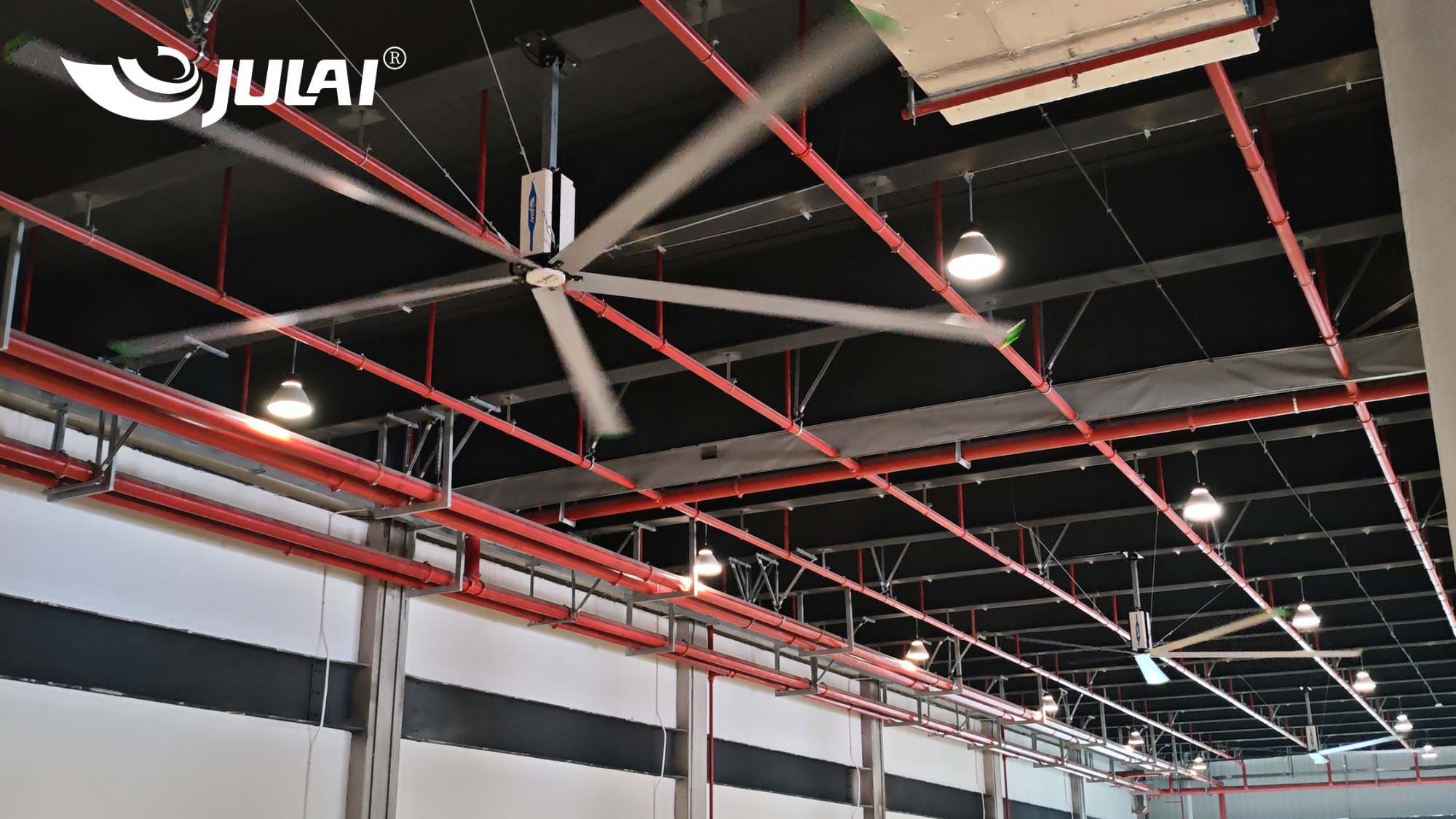
JULAI (Chongqing) Ventilation Equipment Co., Ltd. is a professional high-tech enterprise focusing on the R&D, production and sales of HVLS large industrial fans. We specialize in permanent magnet energy-saving ceiling fans, explosion-proof fans and supporting ventilation system solutions, dedicated to solving high-temperature, stuffy and humid ventilation problems for various tall and large spaces. Adhering to the concept of green energy saving and technological innovation, JULAI keeps empowering industrial upgrading and overseas market layout, and strives to provide reliable ventilation products and professional services for global customers.
In the heat of summer, keeping large production spaces cool and comfortable is a growing challenge for factories, warehouses, and logistics centers. Traditional small fans generate narrow, high-velocity airflow that struggles to cover a whole workshop. Industrial large fans — also known as HVLS (High Volume, Low Speed) fans — offer a practical and cost-effective alternative, delivering wide-area, gentle airflow that keeps large facilities cool and comfortable...
As the standards for operations in various industries and the quality of public environments continue to rise, the demand for ventilation and cooling, as well as environmental comfort, in large and open spaces such as factory buildings, sports venues, and large supermarkets is constantly increasing. These spaces have ample floor heights and high openness, and traditional cooling equipment often fails to meet the actual usage requirements. Instead, super-large industrial fans have gradually become the mainstream choice for ventilation and cooling in such scenarios...
However, the new generation of large fans in the factory have undergone technological iteration and upgrading, achieving multiple breakthroughs in application scenarios under high-temperature conditions, providing an efficient, energy-saving, and stable new solution for the environmental improvement of industrial high-temperature workshops.
As dedicated ventilation and cooling solutions for large factory buildings, industrial large fans are widely applicable to various production workshops, warehouses and large venues. They deliver soft, large-scale air circulation to improve enclosed indoor environments, and have become a mainstream choice for environmental optimization in industrial facilities.
Industrial large fans are widely used in high-temperature and muggy environments. Their core advantages lie in comfortable cooling, efficient ventilation, and dehumidification and moisture prevention. They can provide a comfortable, safe and healthy environment for industrial settings, and are suitable for various large spaces such as workshops, warehouses and exhibition halls...
The energy consumption of industrial large fans' motors is influenced by multiple factors, which can be mainly classified into three categories: the performance of the motor itself, the operating conditions, and the usage environment. Reasonable control of these factors can significantly enhance energy efficiency and reduce operating costs. The performance of the motor itself is the foundation, and different types of motors have obvious differences in energy consumption...
First, pay attention to the size and air volume of the industrial large fan, which is the basis for adapting to the space of the gym. The size of the gym directly determines the choice of the fan. Generally, the diameter of the industrial large fan is positively correlated with the air volume and coverage area. The larger the diameter, the more sufficient the air volume it generates, and the wider the fitness area it can cover. When choosing, it is necessary to combine the actual area of the gym to ensure that the air volume of the fan can meet the overall ventilation needs, creating a refreshing and not stuffy exercise environment for members and avoiding the indoor stuffiness caused by insufficient ventilation...
With the upgrading of the manufacturing industry and the implementation of the "dual carbon" strategy, industrial plants have increasingly strict requirements for ventilation and cooling systems. The pain points of traditional ventilation equipment, such as high energy consumption and uneven coverage, urgently need to be solved. Industrial large fans (HVLS) have become the preferred solution for more and more enterprises to improve plant environments and reduce operating costs due to their prominent advantages of high energy efficiency, wide-area coverage, safety and reliability, injecting new vitality into industrial green production.

 English
  日本語
日本語  Deutsch
  Français
  Español
  Русский
  Português
  繁體中文
繁體中文  Italiano
  한국어
한국어  ဗမာ
ဗမာ  ไทย
ไทย  Tiếng Việt
  Ελληνικά
  नहीं।
नहीं।